
Plotinus and the Gnostics
The War for the World

Hello my loves,
I am back again this week with another long post aimed at my paying subscribers, continuing on with ever more specialized deep dives into Platonism aimed at preparing everyone for the upcoming practical courses and applications, as well as a full introduction into my own tradition that sits on the shoulders of these giants of Greek thought.
I would like to encourage everyone to share my work and subscribe when you get a chance, especially if you have always wanted to adopt a practice with solid roots and properly fleshed out metaphysics but have always found the usual gatekeepers and their online waffling on in “academese” off-putting.
I am here to truly make things accessible, understandable, and digestible. I’m here to talk to you and not the void of the internet.
So make sure that you keep following my potty-mouthed lordship and feel free to ask specific questions or even recommend topics that you would like me to explore. Of course, I will have to prioritize, but rest assured that I will address every serious question I receive.
Now, while the effects of this morning’s meditation session are still with me, let’s pick up where we left off last week in our deep dive into Plotinus’ thought and hope that my vagus nerve will cooperate long enough for me to finish this article before I want to take a hammer to something. Stretch, hydrate, and take your seats.
(NOTE: You will find that I mention “Stacey” a lot in this piece. Why? Well, Stacey was a very self-assured “spiritual” person I knew once. She read Tarot cards without ever sticking to the cards’ meaning, to the symbolism, to the tradition of exegesis itself. Stacey, just knew, through personal ongoing revelation that never corresponded to reality and without any clearly argued reason “everything” there was to know. And she’d fight you for it. We all know a “Stacey.” Also, please note that I often paraphrase or summarize quotations from the sources for brevity or stylistic effect while sticking closely to their meaning. Feel free to check them out for yourselves. Never take anyone’s word. Not even mine).
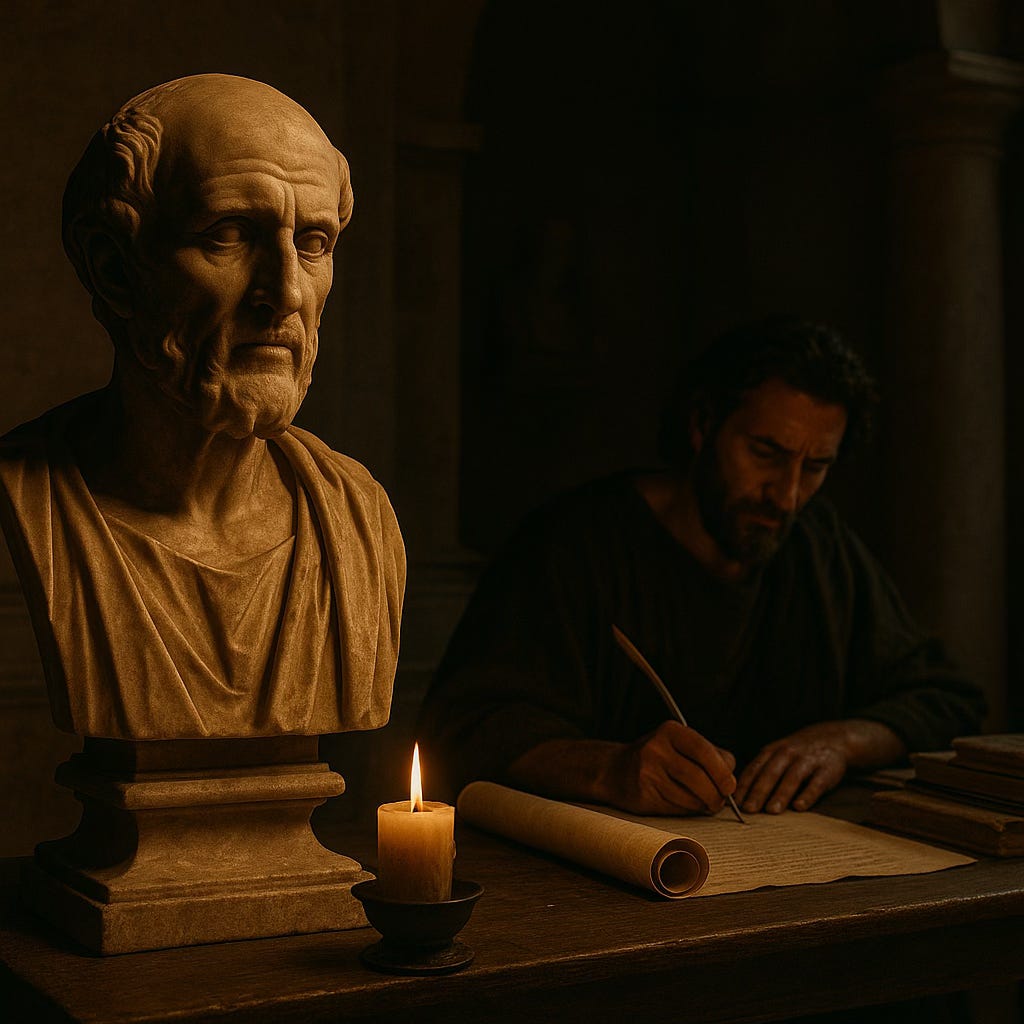
This Is Why We Can’t Have Nice Things
When Plotinus finished laying out the great architecture of the One, Nous, and Soul, he did not expect at all that the next threat to philosophical clarity would come not from the usual suspects—the skeptics or the materialists who looked upon the world of “spirit” and “soul” with the disdain of an evangelical passing by a gay bar—but from a strange and self-assured group of mystics who claimed to possess a higher revelation than anything Plato, Pythagoras, or even the gods themselves had unveiled.
These were men who drifted into his circle in Rome with the air of initiates, promising liberation from the world and disdain for everything in it, like the Aesop’s fox towards the grapes he couldn’t reach.
They were not philosophers in the old sense—men disciplined by argument and self-purification—but spiritual contrarians who saw in the world’s imperfections a reason to condemn the entire cosmos and throw it in the bin.
Plotinus knew their type from Alexandria. He had seen teachers who offered esoteric maps of invisible realms and genealogies of “beings” called archons while sneering at the visible world. But in Rome, the problem became more acute.
These Gnostics, as we call them now, had begun attracting students who might otherwise have been devoted to the slow, inner labor of the Platonic ascent.
They offered an intoxicating promise, much like a salesman who creates a terrible problem out of peeling carrots only to sell you his own contraption: the cosmos is not our home, this body of ours is a putrid prison, the world is a botched experiment of a lesser god, and salvation belongs only to those who possess the secret knowledge that could be yours for just twenty dinars and a pair of tattered sandals.
For those wounded by life or impatient with discipline—that’s practically almost everyone—it was easier to believe this nonsense that the world was inherently evil and warped than to believe that one must transform oneself; that the hell that we experience and inflict upon each other is the result of ignorance and our failure to ascend to our true nature.
Now, Plotinus could tolerate many things as the accomplished philosopher that he was—he lived in an age crowded with mystery cults, prophets, astrologers, and itinerant magicians—but what he could not tolerate was the desecration of the cosmos.
Oh no, not that one. Not on his watch!
He could not abide the idea that the world, the living expression of Soul itself, could be dismissed as a failure.
And so, for one of the only times in his surviving writings, he allowed genuine irritation to crack through his otherwise laconic composure.
The result of this mental inflammation was Ennead II.9, the treatise that later editors renamed into “Against the Gnostics,” though Plotinus himself never used that phrase. He simply refused to let an entire metaphysical worldview collapse into bitterness and cosmic resentment, and all he did was offer counter-arguments to these spiritual emos from the East.
To understand the force of his response, we must imagine the atmosphere of his school again.
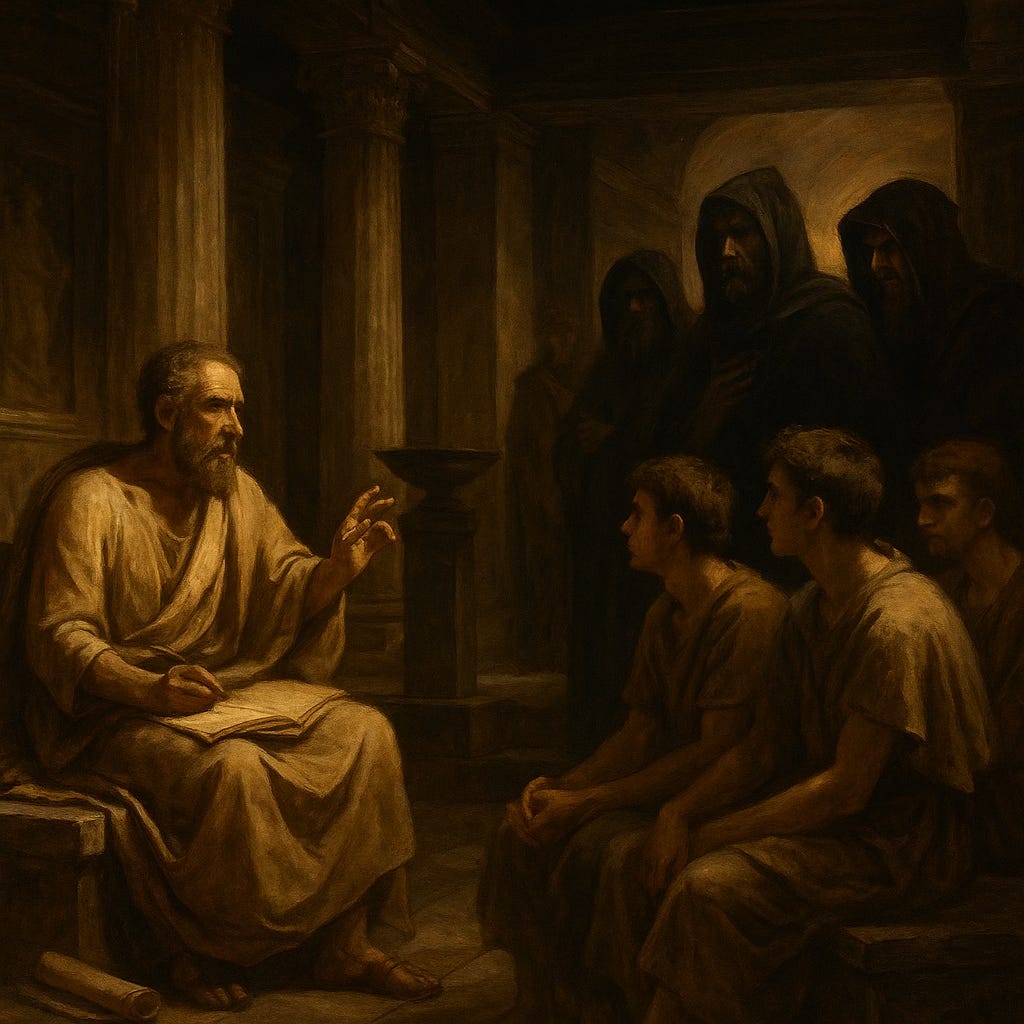
Students gathered in the house of a Roman matron, sitting quietly as Plotinus entered that signature inward state from which he drew his teaching.
And then, amid the contemplative calm, some of these new mystics would interject and speak of the visible heavens as a fraud, the stars as deluders, the earth as a trap, the gods as corrupt subordinates of a blind demiurge.
They would laugh at the world as if it were beneath them. They would claim to be above cosmic law, children of a higher realm unjustly thrown into matter by hostile powers.
They would speak of salvation not as a process of purification, not of ethical transformation, not of intellectual ascent, but of escape like fugitives, like cowards.
Escape—from the very thing Plotinus spent his entire life trying to understand.
The Philosophical Scalpel: You Haven’t Done the Work
Here’s where Plotinus began sharpening his philosophical scalpel on them, not just because the Gnostics weren’t mere pessimists with bad cosmologies—but because they were outright cheeky with it.
They strutted around like morose intellectual peacocks, claiming to possess secret knowledge of the intelligible world while exhibiting all the philosophical discipline of a drunk tourist reading the “Kama Sutra” for the pictures.
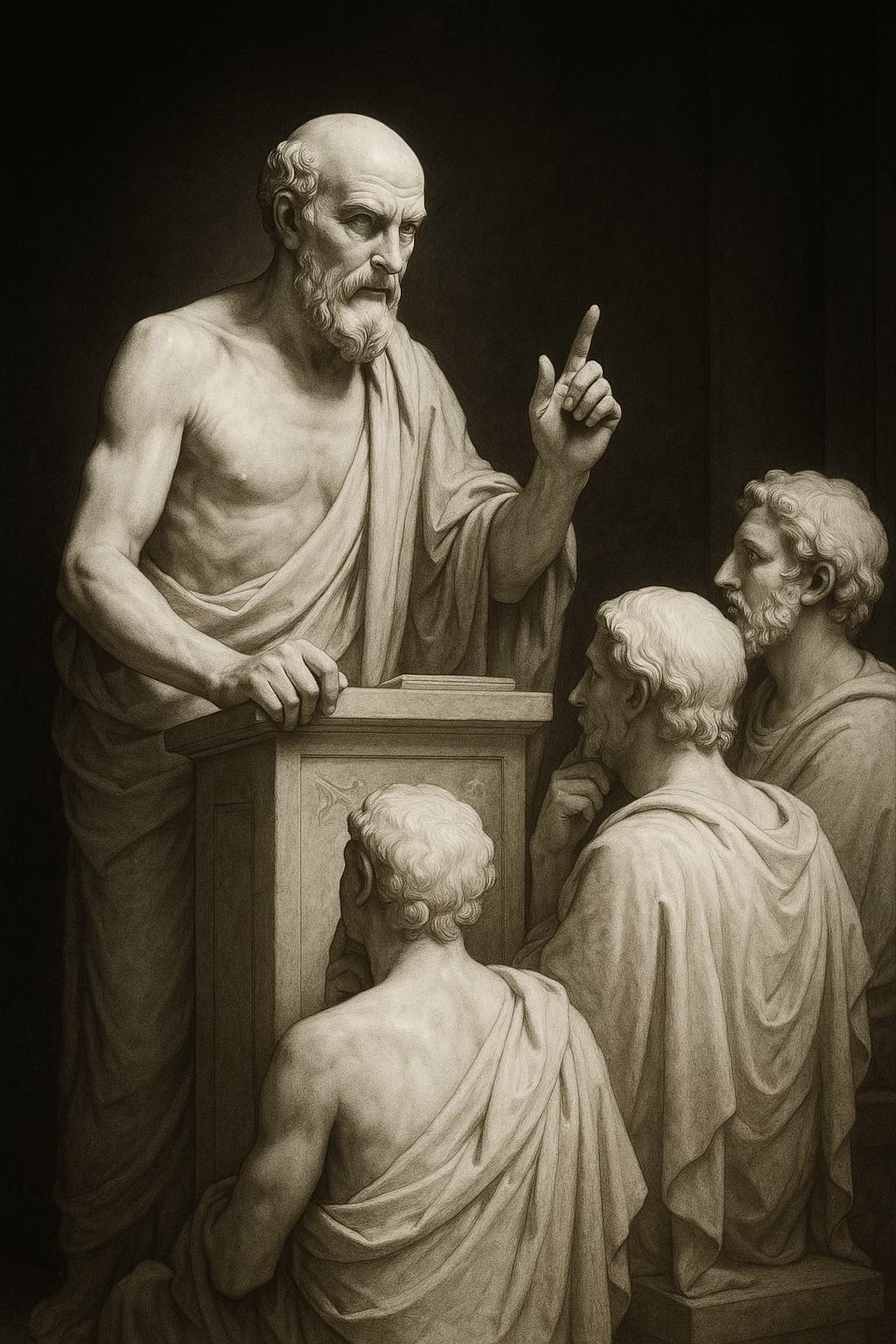
Plotinus called them out with the subtlety of a sledgehammer:
