
Practical Theurgy 5
Presence — Participation, Imagination, and the Signs of Alignment

My loves, my apologies for my recent absence. My belligerent, Doric Greek nature won the inner battle for my soul, and I ended up scrapping like a football hooligan on Twitter with the absolute bottom of the barrel of humanity.
I knew I shouldn’t, at my age and after so much inner cultivation, give into my lower instincts. But like my very wise grandmother used to say: “Sometimes, you must knee someone in the balls!”
Do Twitter scraps ad nauseam with Albanian and Turkish nationalists count as a good kick in the proverbial gonads? Depends on who’s talking and who’s getting kicked. I did manage to make a few block me out of frustration, though. And that made my inner troll happy that after all this time, I still got it!
Immature? You bet!
Totally unbefitting a man of my age? Absolutely!
But what is life if after a certain age we forget how to frolic and roll in the mud? When the inner child that scrapped and threw stones at his would-be bullies retreats in the sarcophagus of propriety and deference in the name of an uptight “maturity” that ends up looking and feeling “stale” rather than “nutritious?”
But enough of my endless online adventures.
We are here to do serious work and attend to our Platonic practice, not recount tales of “glory” on the battlefield. So let’s get down to it and cover the ground that we lost on account of the anniversary of the Fall of Constantinople.
In theurgy and more broadly in spirituality, there comes a point where every practitioner encounters the same problem.
Purification steps, appropriate offerings, hymnology, invocation, can all be learned and practiced until they become mechanical, automatic.
And that’s, quite frankly, the easy part.
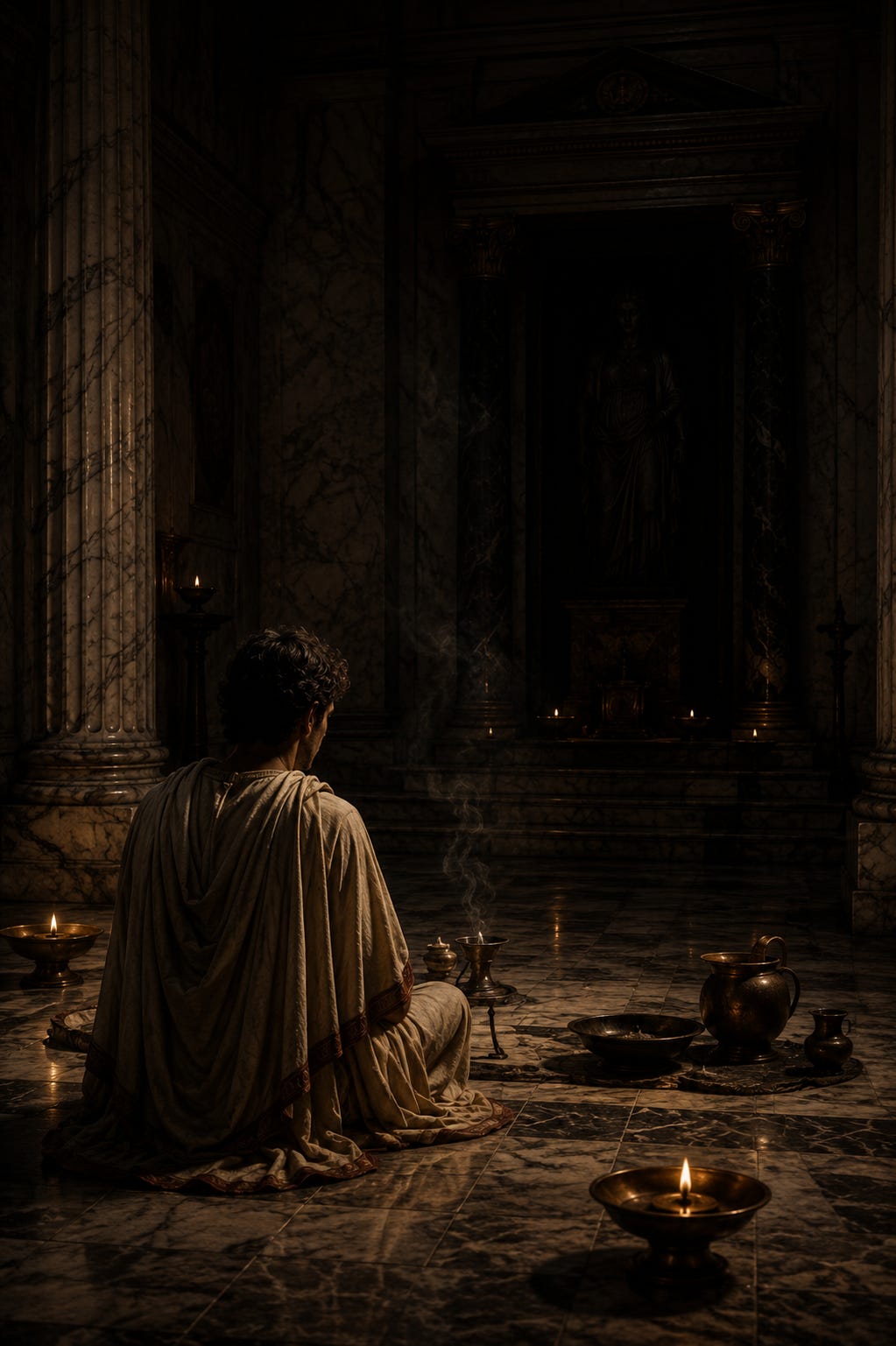
But when the incense has thinned into the air, the final words of the hymn have vanished into silence, the lamp burns low, and the “temple” becomes still. Many end up feeling that the statue on the altar once again appears to be nothing more than stone.
And one is then left alone with a question so uncomfortable that most spiritual traditions spend enormous amounts of energy trying to avoid it.
“Did anything actually happen, or did I simply spend forty minutes talking to myself?”
If you are a solitary practitioner with no community or elders to provide both verbal and emotional feedback, it is a fair question.
In fact, it is more than fair. I’d say that it is downright necessary.
One of the unfortunate habits of modern spirituality is that it often treats doubt as a defect. To question an experience is seen as evidence of weak faith, poor intuition, spiritual immaturity, or worse—a failure to “trust your truth,” whatever that phrase is supposed to mean this week.
The ancients were far less sentimental, as indeed my own elders are today.
Indeed, one of the first surprises awaiting anyone who studies the late Platonists seriously is how extraordinarily cautious they are with “UPG” and other related, religious experiences.
Modern spirituality, having absorbed much of monotheism’s obsession with “faith,”often begins with just a belief in something and then slowly proceeds toward this vague and unverifiable field of “experience.”
Theurgy, on the other hand, works somewhat differently. It begins with discipline and proceeds toward discernment.
Those are not the same thing.
