
Practical Theurgy - pt 10
What the Act of Offering Reveals About the Religious Imagination

Some years back—well OK, many years back—I placed the apple on the altar at dawn.
It was a modest offering—one of the first fruits of the season, still faintly dusted with orchard pollen, its skin unblemished. I had chosen it carefully, turned it over in my hands, felt its weight, breathed in its scent. Then I set it down before the small stone herm in my grandmother’s garden, said a few words that felt right, and walked away.
When I returned in the evening, the apple was still there.
Exactly where I had left it. A little warmer from the sun, perhaps, but otherwise unchanged. The gods had not devoured it. No divine hand had reached down to claim its flesh. It sat there, mundane and stubborn, a piece of produce that had been promoted to sacred status and then promptly ignored—apparently—by the very gods to whom it had been offered.
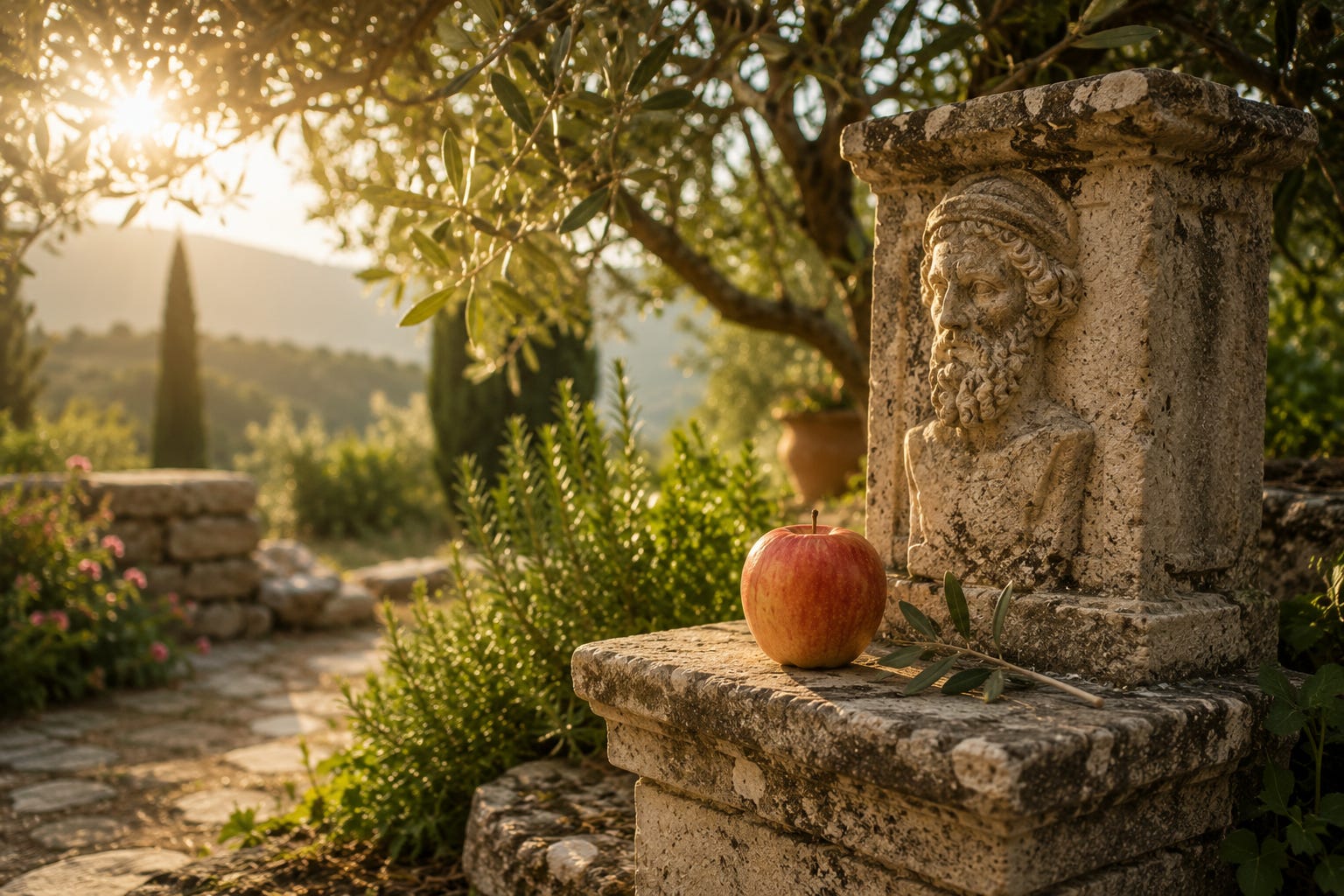
And yet, despite the visible and apparent “rejection,” I felt no disappointment. No sense that the offering itself had failed.
This is the paradox that has haunted me for years, as someone who continues, in the quiet privacy of my own life, to make offerings to gods I cannot see and who do not, as far as I can tell, eat apples or reveal those much-needed, lottery numbers.
Across an extraordinary range of civilizations, human beings have faced the same obvious fact: the gods do not visibly consume what we give them. We have poured wine into the earth, burned incense into the air, left flowers to wither, dedicated statues that never move, and sung hymns that echo into complete silence. And every time, the offering remains, or dissipates, or decays, without any visible sign that it has been received. Unless your name is Abraham and the Voice tells you to slaughter your own son.
So why did we persist in giving things to “entities” that do not seem all that interested in what we’re offering?
The answer, I have come to believe, is not about how to offer, or even what to offer, but about why we offer at all.
The eternal apple on the altar is not a transaction. It is not a bribe, a payment, or even—in the strict sense—a sacrifice. But it certainly is a gesture. A word made flesh. A piece of the world set apart because giving, under certain conditions, becomes an act of recognition of something, someone, and the relationship between them and us.
Sounds a tad woo-woo-ish? You bet, but I woke up like this. Mercury is almost out of my Cancerian hair and I’m feeling a certain way.
Bear with me.
I. The Universal Language of Giving
On another occasion, during a school excursion to a nearby forest —yes, they used to take us out of school for the day and let us run in the fields—I watched a five-year-old present a dandelion to her mother during their mother-and-daughter picnic.
The flower was already wilting, its stem bent, its yellow petals beginning to curl at the edges. It was, by any objective measure, a rather sorry specimen of a flower picked in a field full of far better and more fragrant flowers. But the child held it out with both hands, beaming, as though she had discovered treasure. Her mother received it with the gravity of a queen accepting a crown. She took her in her lap, put the flower in her hair and then ruffled it all up, followed by a smooch on the nose.

Something about that moment has never left me. It was not about the flower. It was about its giving. The gesture itself communicated something that words could not: affection, attention, the desire to share something beautiful with someone beloved.
Anthropologists will tell you that gift-giving is one of humanity’s oldest and most universal instincts. Children give without being taught—and yes, they do tend to take it back and flush it in the toilet moments later but they give it first, instinctively.
Families exchange gifts. Guests arrive bearing gifts—in fact, in Greece, none of us would dream of showing up to someone’s home without something, anything!
The hosts then reciprocate, even if they share the very gift you brought them.
In older, less enlightened times, people brought their kings gifts and they graciously received the tribute that they could theoretically—as they often did—order it brought to them.
Entire communities, religious and civic routinely feasted together.
Marcel Mauss, in his classic study The Gift (In Swedish it means “poison” btw), observed that these exchanges are never merely economic. They are social acts that bind people together, create obligations, and express relationships.
Religion, being—at least theoretically—a relationship as well, also inherits this language.
Looking through excavation reports, sanctuary inventories, and museum collections, one quickly encounters offerings from the very beginning of our somewhat complicated with things we cannot see or touch.
In Paleolithic burials, we find tools, shells, pigments, and ornaments placed with the dead—objects whose precise meanings remain debated, but which plainly exceeded the requirements of disposal alone.
In Mesopotamia, clay tablets record lists of offerings to the gods alongside inventories of royal tribute. In China, bronze vessels filled with grain and wine were buried in royal tombs.
And in Greece, the sanctuaries are filled with the debris of millennia of such giving: broken pottery, animal bones, small figurines, and, occasionally, exquisite works of art that someone once left behind.
The forms and the arrangements do change, but the impulse does not.
This is not a coincidence, because the language of giving appears to be built into the very fabric of human relationships. So when we offer something to a god, we are doing what we have always done: we are extending a relationship, acknowledging a presence, expressing a hope. The god may not eat the apple, but the apple still speaks. It says in a silent but still physically present way: “I am here, I am paying attention and I am grateful—by the way, any chance I can have those Lotto numbers?”
But if all offerings are gifts, we must ask: what makes a religious gift different from a puny dandelion offered to a mother? What is it, in other words, that transforms an almost compulsive, social gesture into a sacred act?
II. Not Every Offering Is a Sacrifice
Walter Burkert’s account of Greek ritual changed the way we understood the word “offering.”
Greek worship was never exhausted by the spectacle of animal sacrifice. Alongside thysiai stood libations, first fruits, incense, votive dedications, hymns, dances, processions, and festivals: all distinct ritual forms united by the fact that something was presented, relinquished, or performed in honor of a god.
I remember reading that and thinking: duh! And also: why did we ever think otherwise?
Modern readers tend to fixate on slaughtered animals when we hear the word “sacrifice.”
We imagine the altar, the priest, the knife, the blood, the burning flesh in a stabby, gutty, eyes-all-wide-open, bloodthirsty ecstasy.
The Iliad itself opens with a plague sent by Apollo because Agamemnon refused to return a priest’s daughter; the solution to the plague involves a sacrifice. Its sequel, the Odyssey ends with Odysseus purifying his hall with sulfur and further offerings.
The tragedies as well are full of sacrificial imagery so naturally, sacrifice looms large in the imagination.
But that is not the whole story behind giving to the gods.
Let us consider the evidence.
At the sanctuary of Apollo at Delphi, the offerings that survive are primarily objects and not gutted, cute woolly creatures: tripods, statues, weapons, jewelry, coins, or even inscriptions. At Olympia, the victors dedicated bronze helmets, terracotta figurines, and elaborate chariot groups. At the Acropolis in Athens, the archaeological record is a sea of small dedications: pots, plaques, and marble korai statues that once stood in the precinct of Athena.
And then there are the things that leave no trace at all.
Libations of wine and milk. First fruits of grain and honey. Incense that has long since turned to ash and smoke. Hymns that were sung and then forgotten. Dances that were performed and then disappeared or evolved into something that girls do on top of tables across clubs in Greece today. Athletic victories that were celebrated and then became memory.
Robert Parker, in his magisterial work on Greek religion—highly recommended—makes this point with characteristic clarity: the category of “offering” in Greek religion is vast. It includes not only sacrifice but also prayer, song, dance, procession, temple-building, and the dedication of everything from a lock of hair to a captured ship.
I once stood in the national archaeological museum in Athens, looking at a small clay plaque from the 6th century BCE. It showed a woman leading a goat to the altar, her hand raised in prayer. The plaque was no larger than my hand. It was not a remnant of an “actual” sacrifice but a representation of a sacrifice—a dedication made to the gods by someone who wanted to commemorate an act of piety.
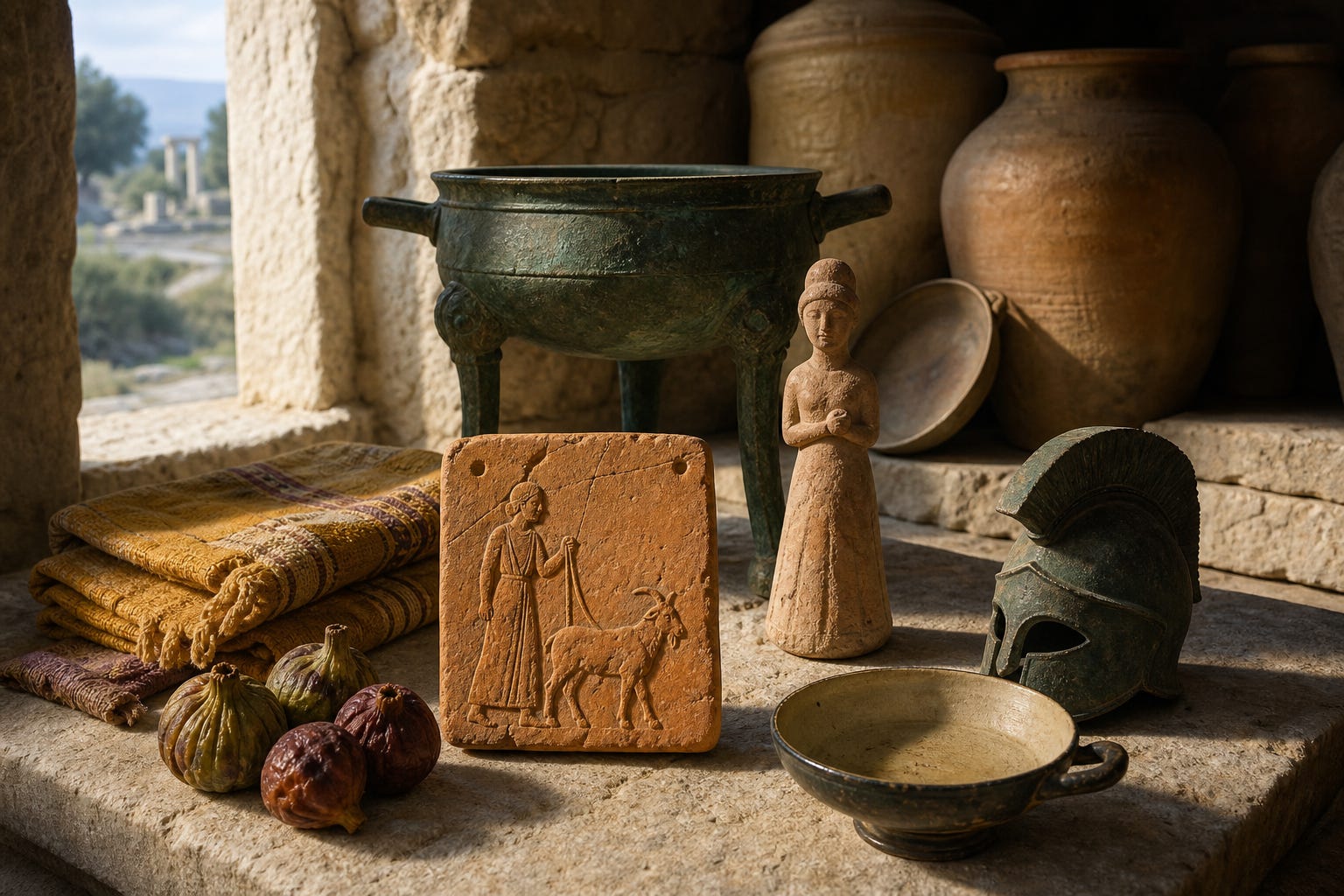
The plaque survives. The goat, if ever there was one, is long gone.
What unites these offerings, however, is not their form but their underlying logic. They are all acts of giving that establish, maintain, or restore a relationship between humans and gods. They are all expressions of piety, gratitude, hope, or remembrance. And they all share one crucial feature: they are things that are simply just given away.
But if the category of offering is so broad, we must then ask: what makes a gift worthy of the gods to begin with? Does it have to be something “pretty”? If so, why?
III. Why the Gods Receive Beautiful Things
By this age I have spent enough time in museums to recognize the quality of a Greek dedication without even bothering about reading the label.
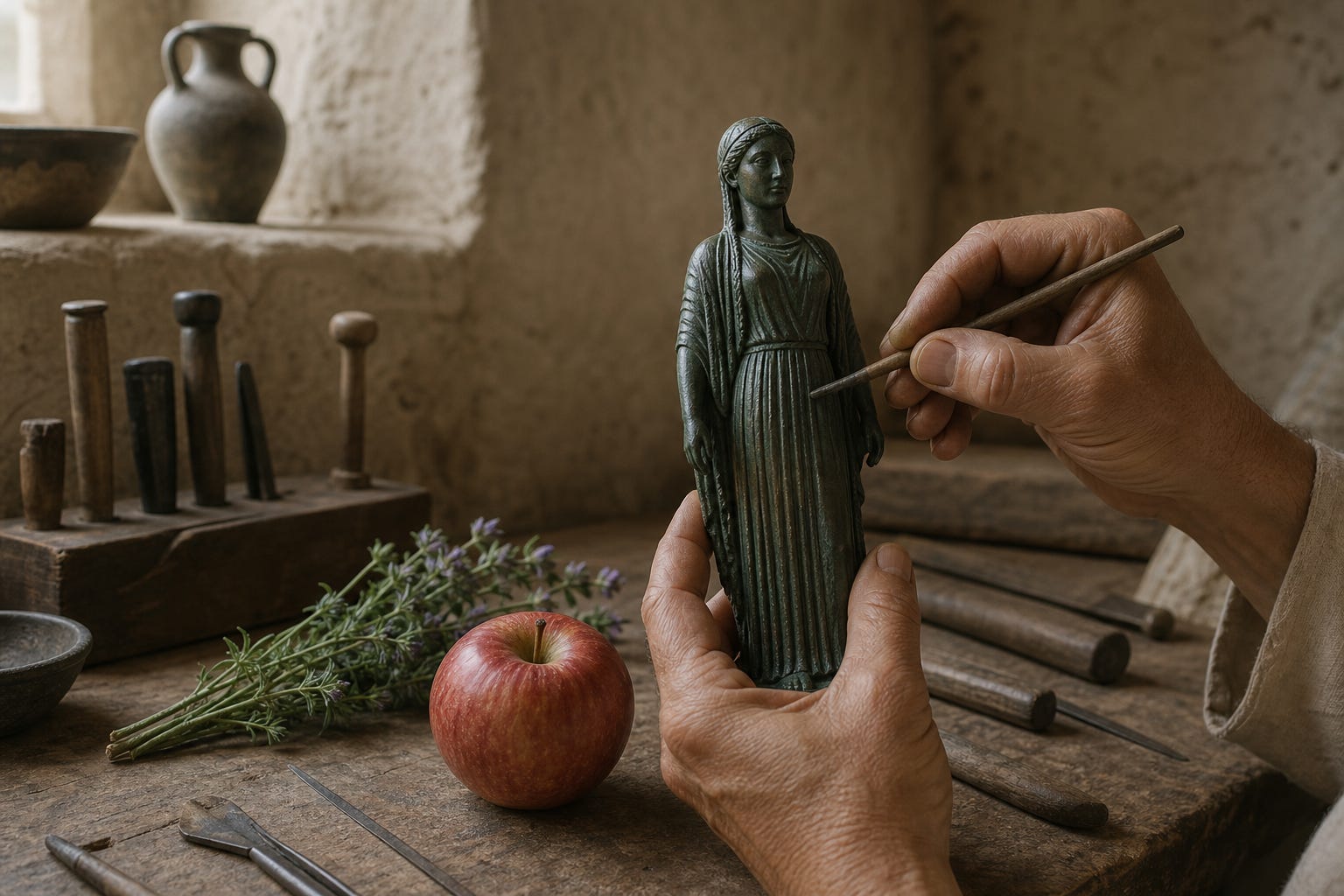
The small bronze kouros from the 7th century BCE—formal, compressed, and severe in its archaic geometry—belongs to a very different world of workmanship from the marble Kore from the Acropolis, with her smile, the rich folds of her peplos, and the delicate rendering of her hair. Both belonged to the world of dedication to Athena, though they represent radically different scales of material, labor, and expense.
The bronze figure may have been modest beside the marble Kore, but modesty did not exclude its fitness. Each could answer to the circumstances and means of its dedication. In both cases, the offering was beautiful.
Not expensive, necessarily, nor elaborate or grandiose.
But beautiful in the sense that the Greeks associated with the concept “kalón”—a word that could mean good, fine, well-made, or fitting depending on the context. The small bronze kouros was appropriate to its occasion; the marble Kore was magnificent.
Each fulfilled the same requirement: the offering had to be “worthy.”
But why does worthiness matter in the first place?
To understand this further, we must see how my ancestors saw “kállos” because they went much deeper than mere aesthetic preference.
For Plato, beauty or “fine-ness” was not a subjective decoration we project onto the world. In the Symposium, Diotima describes a ladder of beauty—a gradual ascent from the love of a single beautiful body, to the love of all beautiful bodies, to the beauty of souls, to the beauty of laws and institutions, and finally to Beauty—capital B—itself, eternal and unchanging.
So the object recognized in the moment as “fine” or “beautiful” is but a stepping stone that draws the soul upward, away from the particular and toward the divine.
Plato here, or anywhere, does not provide us with the ordinary worshipper’s explanation for choosing a flawless apple or commissioning a fine statue.
He does, however, give philosophical expression to an intuition already visible in cult: beauty can disclose a deeper order of reality, one that exceeds the merely human. The rationale of a “fine” offering is therefore that of a small piece of harmony and proportion placed before the divine.
It’s an answer to beauty with more…beauty.
Beauty, in this context, is not merely a carefully curated object, picked for its aesthetic resonance, aimed to impress the receiver. It is a kind of recognition of the receiver and their inherent relationship with the object offered to them.
It is the visible acknowledgment that the world is not random chaos but an ordered cosmos (an embellishment, a jewel), and that the gods to whom the offer is being made are the principle of that order.
The flawless apple, the fragrant incense, the well-tuned, well-worded hymn, are not bribes. They are not picked according to a scale of price, preciousness. They are picked as momentarily recognized imitations of the divine nature, placed back in the hands of their source. They don’t have to be bought from a pretentious, upscale shop, they could be a simple flower, a dandelion picked out of a bunch of dandelions in a field—just don’t pick the wilted, dry one, you are not five.
IV. The Moment Something Stops Belonging to You
Watching the smoke rise from a ritual fire—whether during a modern reconstruction or simply in the mind’s eye from the ancient accounts—one feels the weight of what is happening.
The fire, the offering, the smell of burning, the sense that something was being surrendered beyond retrieval.
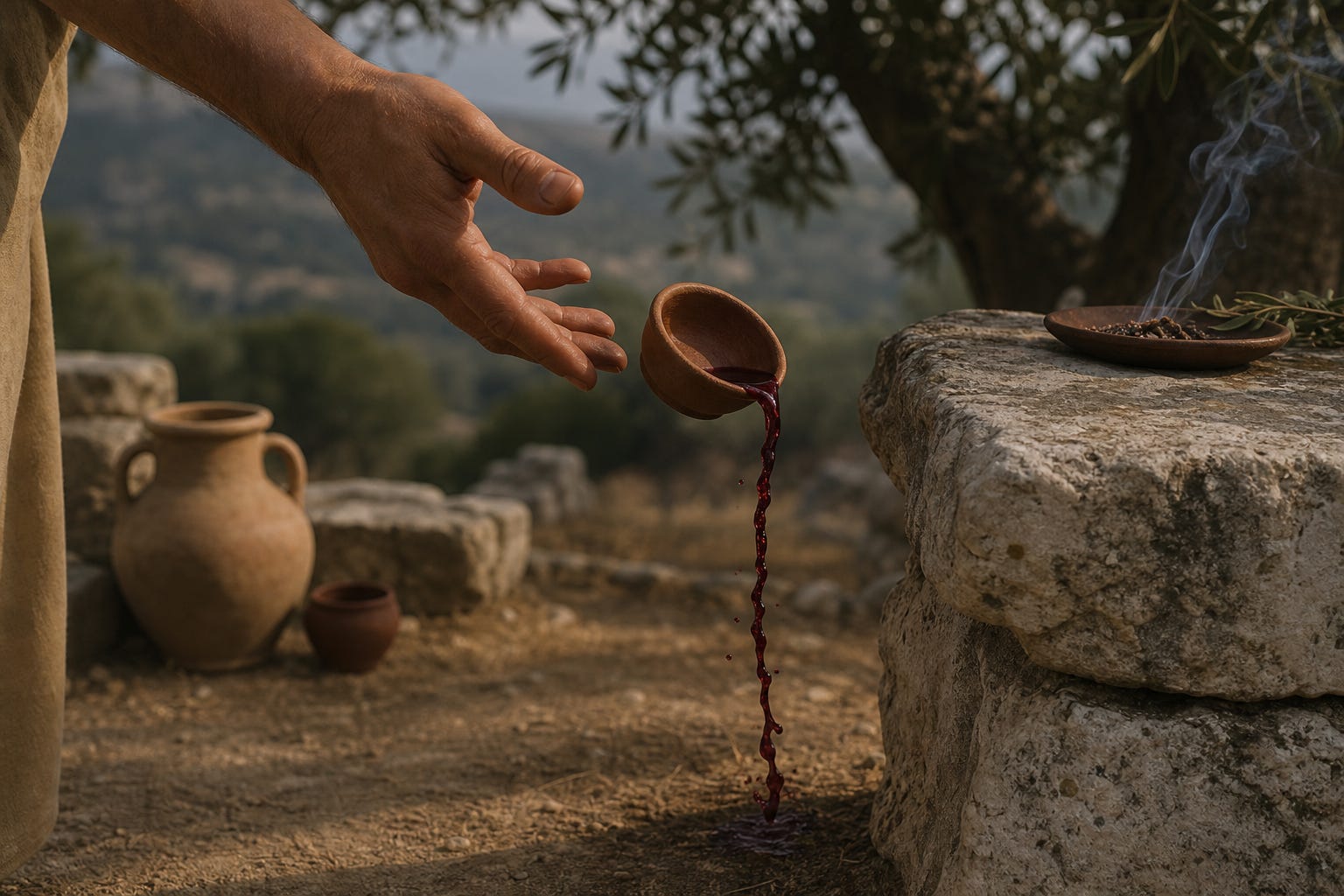
Animal sacrifice is the form of offering that modern people find most difficult to understand. We see the blood, the killing, the burning of flesh, and we recoil. We imagine primitive brutality, violent appeasement, and dark god who demands blood to be satisfied. While surely, such beliefs have periodically been espoused by various communities under the leadership of not so stable individuals, I have come to see “sacrifice” rather differently.
The Greek term thysia belongs to the family of thuein, a verb historically associated with burning, producing smoke, and making an offering. But the religious significance of the act cannot be reduced to mere combustion. The death of the animal was not the whole meaning of the rite. The crucial element was consecration.
“Yes! But the poor lamb still died!!”
Spare me.
Your bacon tasted very scrumptious this morning, did it not? Did you pause and shed a tear for the piglet, or did you order a milkshake to wash down the grief with it?
Modern scholars often emphasize the irreversibility of sacrifice—the fact that the wine cannot be gathered back, the incense cannot be unburned and yes, the poor lamb cannot have its throat uncut.
This is true, but it is psychologically true rather than theologically central.
The ancients themselves rarely describe sacrifice primarily as deliberate destruction of produce and life.
Instead, they constantly describe it as a setting apart. As consecrating. As removing something from ordinary circulation and making it unavailable for ordinary use.
This is where the real power of the offering lies, in that the offering (sacrifice) interrupts ownership over the thing offered.
The moment something becomes a religious sacrifice, it no longer belongs to commerce, appetite or utility. It has crossed a threshold to a further beyond where you can no longer take it back from, it has entered sacred history.
This is difficult to articulate fully because we moderns are so accustomed to thinking of property as an absolute, something to owned and hoarded, retrieved if lost. The ancients, however, rarely imagined themselves absolute owners. Harvests, victories, children, health, and prosperity arrived first as gifts before they could ever become offerings. They were not guaranteed to begin with and their presence in their lives was always temporary—everything came and went.
This is why first-fruits offerings made such profound sense: the apple, the grain, the wine were never truly theirs from the beginning.
The apple I place on the altar can no longer be eaten by me. I cannot sell it. I cannot give it to a friend. I cannot trade it for something else. Once placed there, I have willingly and irrevocably relinquished it. It is no longer subject to my private discretion, but it has been transferred from ordinary possession into sacred custody within an ordered cosmos.
Seen in this light, the astonishing diversity of Greek offerings begins to collapse into a single, fairly straightforward idea. Whether apple, hymn, tripod, procession, or sacrifice, each has undergone the same transformation. It has ceased to belong wholly to the ordinary world. It has become an anathēma (ανάθημα)—something “set up” for a god (not an aνάθεμα). The term does not encompass every ritual act listed here, but it captures their shared movement: something that has crossed out of unrestricted human possession and into a sacred relation.
But the change is not always an immediate permanent withdrawal from physical use.
A sacrificial animal for example was not burnt whole outright, it was often consumed in a sacred meal within the community. Likewise, a votive object might have been displayed in the sanctuary for generations, or a dedicated tripod might have been stored in an oracle’s treasury.
The point is not that the object ceases to exist necessarily or it is never touched again.
The point is that “a change of status and jurisdiction” takes place at the moment of irrevocable relinquishment. What is consecrated is no longer available on precisely the same terms as before. Its use is now governed by the god, the sanctuary, and the rite.
The apple that I placed on that altar was not immediately destroyed. But it was no longer mine, so I did not take it back and eat it by nightfall. It stayed out there until the divine squirrels took it to the Great Beyond.
But despite its concrete physical presence or lack thereof, once an offering has been consecrated in this way, it often leaves a trace—a memory inside our psyche and in the space around us that refuses to fade.
V. The Memory of Gratitude Made Visible
Years ago, while reading the healing inscriptions from Epidaurus—even through editions, photographs, and museum displays—I encountered stories that moved me more than I expected.
The surviving healing inscriptions tell of blindness relieved, pregnancies granted, foreign objects expelled from bodies, and illnesses cured after incubation. Whatever we make of each story historically, their function within the sanctuary is unmistakable: they turn private deliverance into public evidence.
The Epidaurian inscriptions gave these cures a durable public form.
Elsewhere in sanctuaries, individual gratitude could take material shape in anathēmata: objects set up for a god, from anatomical votives and personal ornaments to weapons, statues, and costly monuments.
They were not merely reminders for the individual who dedicated them but timeless testimonies. They proclaimed, to every visitor who entered the sanctuary, that the gods were real, that they heard prayers, and that they acted in the lives of mortals.
Looking through excavation reports from such sites, one usually finds the most personal objects: a child’s toy, a woman’s hairpin, a warrior’s shield, a sailor’s anchor. Each one tells a story. Each one was left behind by someone who had been through something and wanted to declare it, publicly and permanently, within the god’s domain.
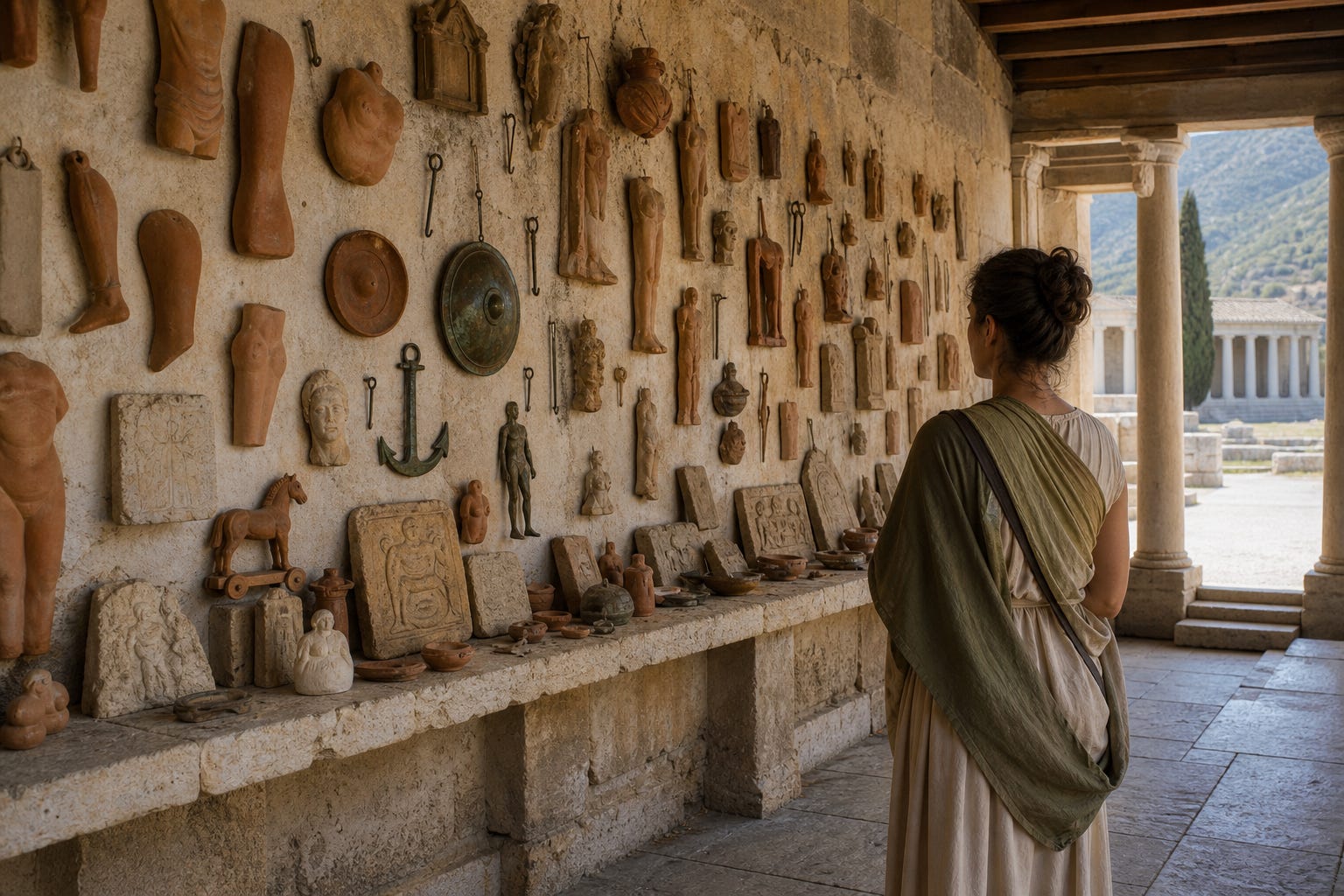
In a way, we can say that the sanctuaries became living conversations between generations.
We could walk through a Greek sanctuary and read the history of a entire community in its offerings: the tripods dedicated after a victory in war, the statues set up by successful athletes, the altars raised by grateful merchants, the tablets recording miraculous healings. Every new visitor saw the accumulations of centuries of testimony and every new offering added to the chorus.
This is more than private, individual remembrance. The sanctuary did not merely store personal gratitude in physical objects, it displayed to the public the evidence, the proof of a dialogue with the eternal, left behind, in time and space.
VI. When an Entire City Becomes an Offering
Watching a modern reenactment of the Panathenaic procession—even a modest one—one catches a glimpse of what it must have been like.
The robed figures, the small wooden ship on wheels, the draped peplos, the echo of aulos pipes. For a few hours, the city became something entirely different. It was not just a modern metropolis but a ritual space.
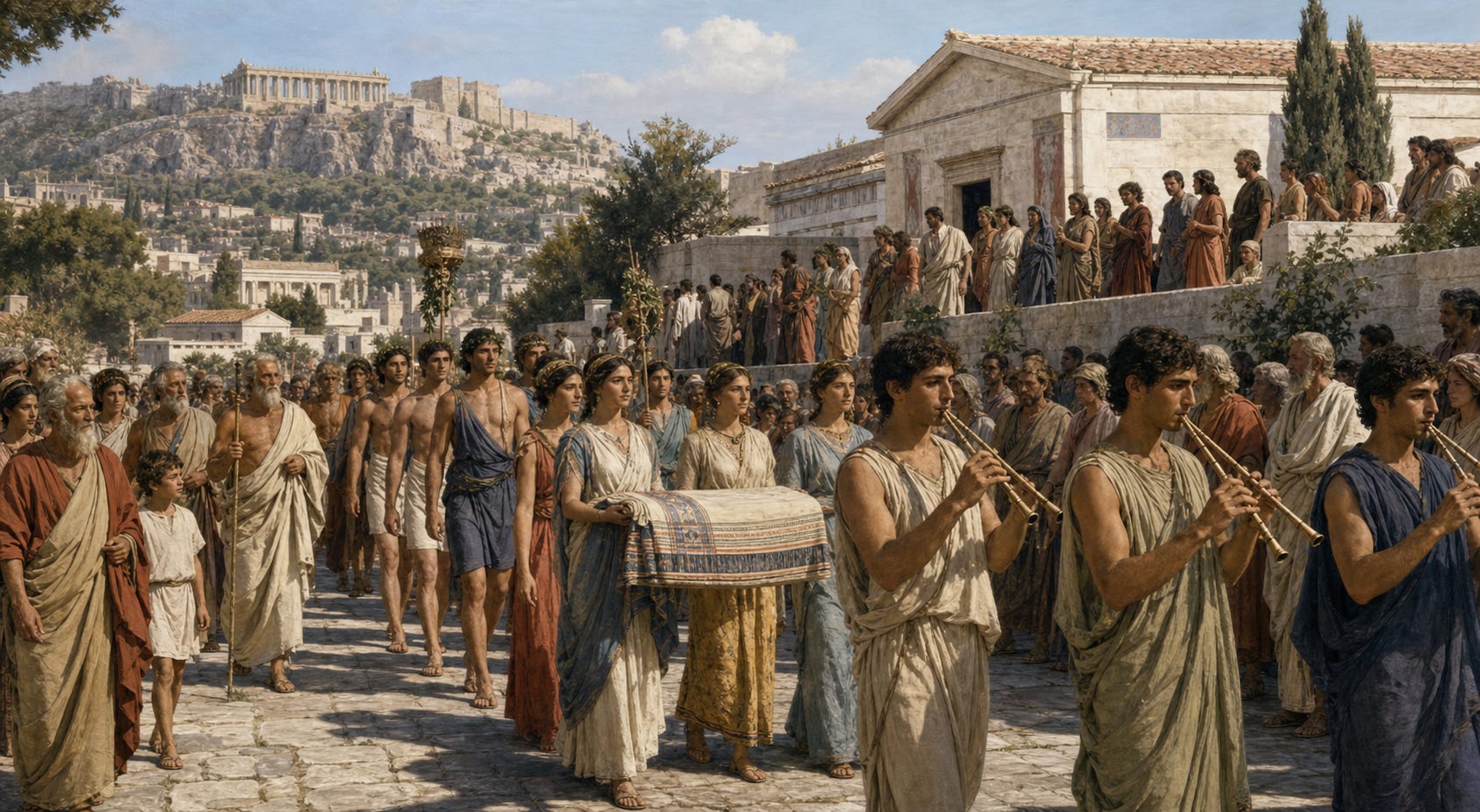
The Panathenaea was never a single sacrifice, then or now. It has always been a multiplication of offerings. Processions, choral songs, athletic contests, musical competitions, and a grand sacrifice to Athena, all took place over a period of days.
The Dionysia, another festival was similar: dramatic performances that honored the god with new works of poetry.
As were the Olympic Games, in their essence, a festival of offerings—athletic victories dedicated to Zeus.
Of course, we must resist the temptation that festivals were just naive escapes from politics, the daily hustle and bustle of the mundane affairs of the city. They were, in fact, saturated with it. Rank marched in procession and wealth financed the choruses and the sacrifices. Tribal and interpersonal rivalry became athletic and dramatic competition.
So, during an otherwise “religious” festival, the city displayed not what it was free from, but what it believed its powers were for.
For a few days, commerce and politics did not disappear. In essence, we can say that they were reorganized inside a sacred frame.
When a city threw a festival, it was not just entertaining itself, throwing a party or a set of games around a mythological theme. It was giving something to the gods. It was offering its time, its wealth, its creativity, and its communal solidarity.
The entire celebration was a dedicated gift, set aside in its “beauty” and “suchness” for the deity.
I have stood in the theater of Dionysus and tried to imagine the first performance of a tragedy: thousands of citizens gathered, watching a chorus sing of the suffering of Oedipus or the vengeance of Medea.
You can say that it would have been a kind of entertainment, yes.
But it was also a display of piety.
The playwrights competed fiercely for prizes, sure. But the competition itself belonged to the festival of Dionysus and as a consequence to him.
From all the above, we can clearly see that when a city becomes an offering, it is transformed. The community remembers what it is for, and that it exists not merely to survive but to create, to celebrate, and to honor.
It interrupts its own ordinary existence and sets itself, beautifully, as a gift to the divine.
And if a whole city can then become an offering, it must be because the individuals within it have learned from childhood to give well.
VII. The Character of the Giver
Modern moral taste often assumes that a gift becomes purer as the giver disappears. Anonymous charity is considered in our days more virtuous than named philanthropy.
In the minds of the ancients however, there was less certainty in that assumption.
The Greeks gave publicly. The names of those making an offering were inscribed.
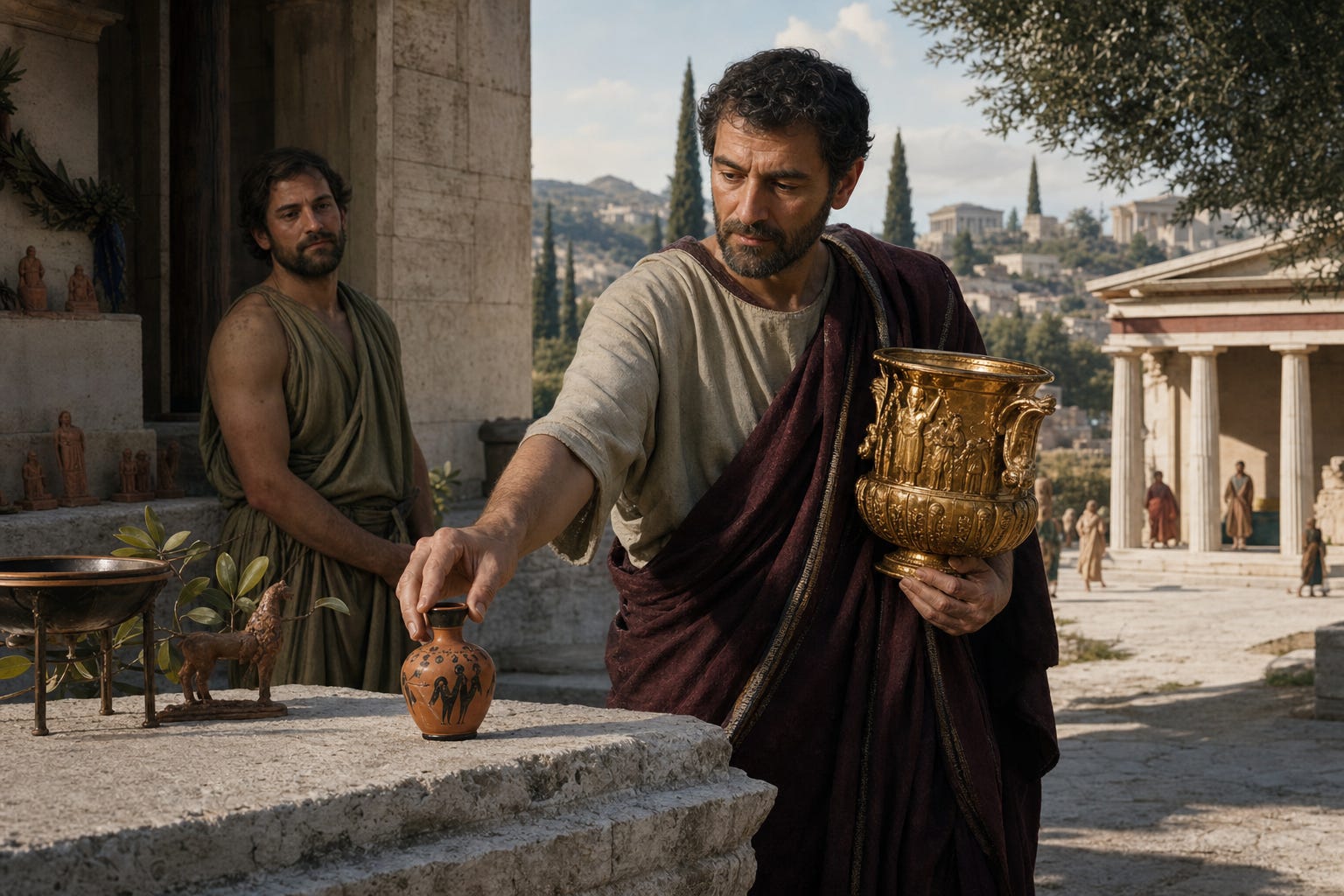
Their victories were proclaimed.
Families displayed their wealth and benefactors expected honor from the public that they generously benefited with their public offering.
A donor could seek honor, beautify a sanctuary, advertise family status, and honor the gods simultaneously and none of that excluded the other.
The difficult question was not whether the donor was visible, but whether the scale and form of the gift were fitting to the occasion.
Aristotle wrote about megaloprepeia—magnificence—as a virtue.
It is the disposition to spend money on great things, on public goods and on worthy causes.
But he was careful to distinguish that from extravagance.
Magnificence is not about spending a lot but about spending it appropriately.
It is about doing the right thing, in the right way, for the right reason.
The offering, in Greek thought, is a disclosure of the giver’s character. A lavish dedication can express gratitude, civic generosity, or piety. But it can also advertise vanity, insecurity, or self-importance. A humble gift might reflect genuine devotion or simple poverty. The moral weight of the offering lies not in its market value but in the disposition it manifests.
Consider the competitive dedications at Delphi, where city-states and individuals vied to erect the most impressive monuments. Consider the choregic monuments in Athens, where wealthy citizens proudly recorded their funding of dramatic choruses.
None of these were acts of private piety. They were public performances of civic virtue.
The question the Greeks asked of themselves and each other was not
“Did you give anonymously?” but “Did you give fittingly?”
And the disposition to give well is the disposition to recognize that not everything in the world exists to be consumed by us exclusively.
VIII. The Generosity of Being
We have now reached a question that anthropology alone cannot answer.
If offerings are gifts, and if gifts are acts of recognition, and if recognition involves transfer into sacred custody, what kind of world makes such transfers meaningful?
Neoplatonism offers a distinctive answer. It does not teach that the cosmos is generous in a sentimental or moralistic sense.
Rather, it teaches that perfection is productive. What is full communicates being without becoming empty.
Plotinus describes the Good as giving without diminution. The One is not diminished by the procession of Intellect from it, nor Intellect by the procession of Soul. Each lower level depends upon its source without depleting that source.
Reality in itself is generous.
The cosmos is not a closed system of scarce resources but by nature, an overflowing fountain of being, pouring forth without loss.
Seen through a Neoplatonic lens, offering is no longer merely a human custom described by anthropology. It can be read as a mortal answer to superabundance: not a copy of divine procession, but an acknowledgment that what we possess came to us within an order of prior giving.
When we offer something to the gods, we are therefore not performing a transaction, a “do ut dos,” one favor for another.
We are not even primarily “humbling ourselves” or teaching ourselves to let go, unburden ourselves from the guilt of being born into money.
We simply answer, in an act of reciprocity, the boundless generosity of being, with generosity.
We become in other words, participants in that same pattern of overflowing that starts with the One and cascades through down to us.
The offering therefore declares that not everything in the world exists to be consumed. By surrendering one small thing to sacred custody, the giver acknowledges that order of prior generosity: beauty was not invented by us, harvests were not summoned from nothing by us, and being itself was not our achievement.
The gift answers what has already been given.
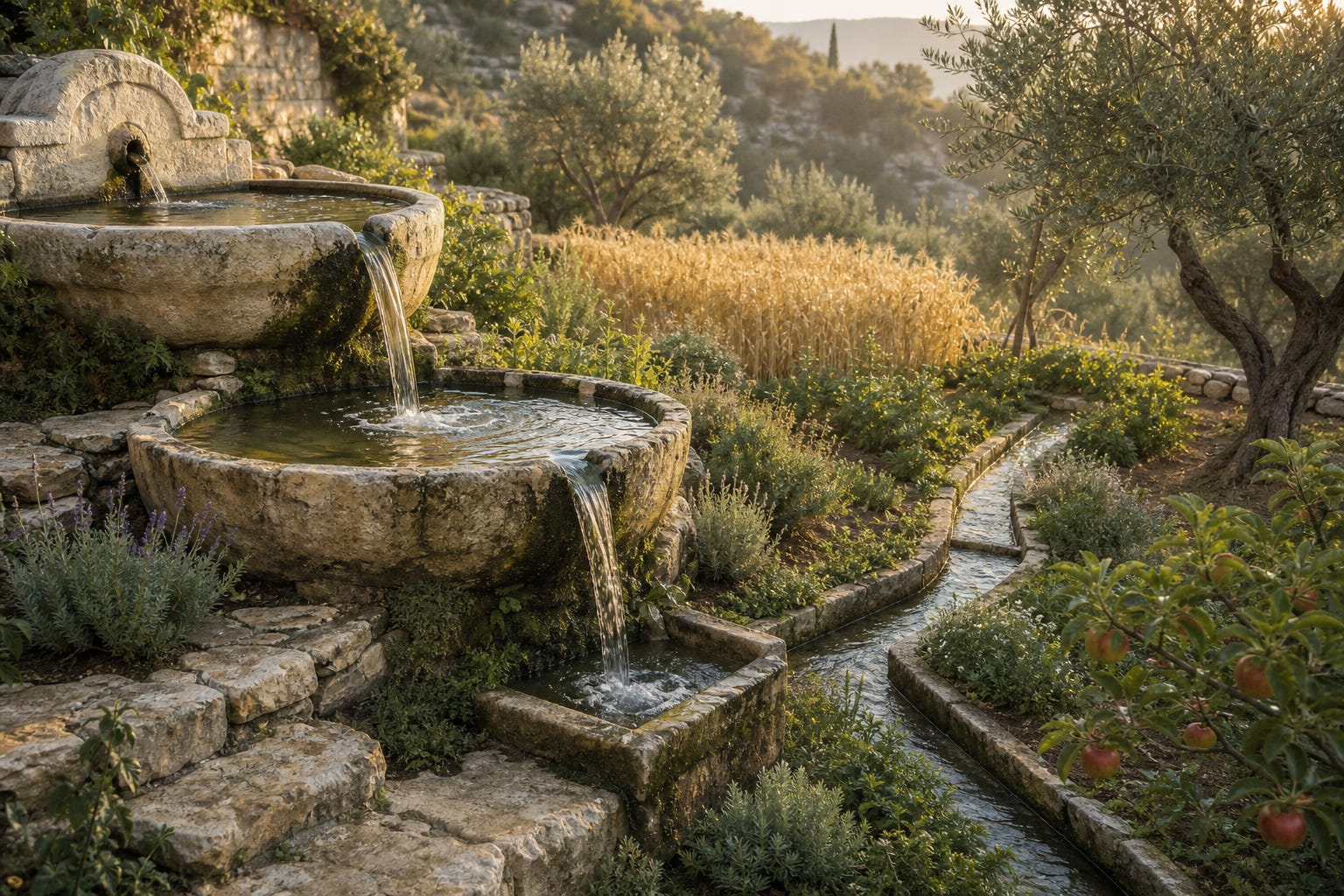
A Beautiful World
Let us return, finally, to the apple.
It remained on the altar for several days, growing softer beneath the sun until the first brown patches appeared on its skin.
Before long, some creature from the garden had sampled it—perhaps a squirrel, perhaps a bird, perhaps one of the lesser woodland divinities operating without a formal priesthood.
When what remained began to rot, I buried it beneath the soil.
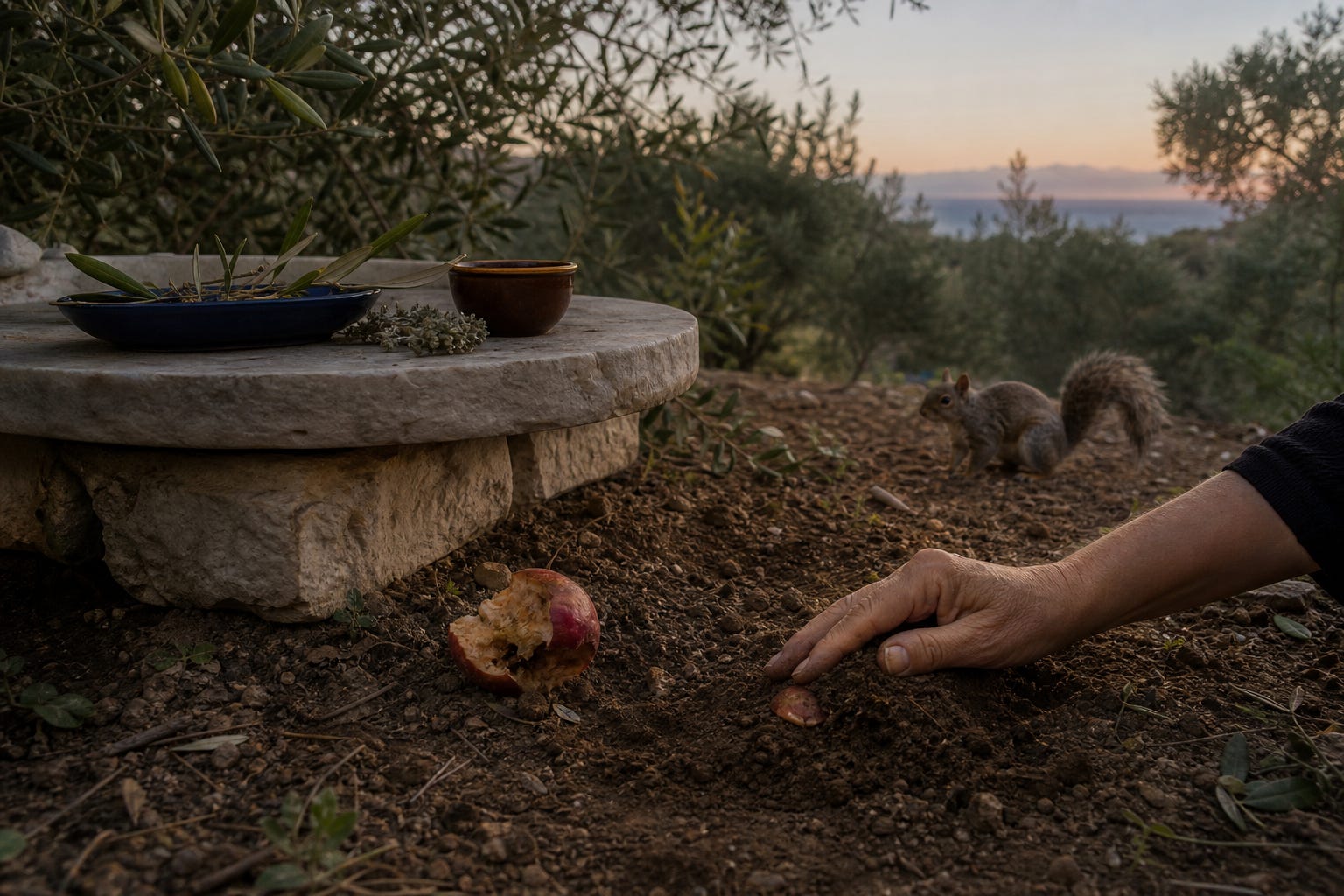
The gods never ate the apple. They never stretched out a hand to take it, never sent a flash of light through the garden, never whispered the winning lottery numbers into my ear. It remained exactly where I had placed it until the earth and its smaller citizens reclaimed it.
And yet I offered another apple the following year.
Then another.
I continued until I left my grandmother’s home, not because I had misunderstood what was happening, but because I had finally begun to understand it.
The apple had ceased to be breakfast.
For several days, it belonged neither to my appetite nor to the market, neither to usefulness nor possession.
It had been taken out of the ordinary traffic of things and placed inside a relationship. That relationship did not depend upon the apple vanishing before my eyes. It depended upon my giving it without taking it back.
Perhaps this is what an offering has always been: not food successfully delivered to an invisible mouth, but recognition given a physical form.
The world had already given first—the soil, the rain, the tree, the season, the fruit, and the life capable of receiving them. My apple was not repayment. No apple could settle such an account.
It was simply an answer.
The gods never ate the apple.
But then, it had never been placed there merely to be eaten.