
Practical Theurgy pt 8
Prayer

My Dear Loves,
Especially my American loves, who are really going through it this 4th of July, be it on account of the maddening heat, or the batshit cuckoo politics and the very real, expensive, frustrating, practical mess that they have wreaked in your delicate and beautiful lives, I see you, I feel you, and I pray for you. I wish you a Happy July 4th and I hope that one day soon, the Sun of Reason, Mercy, and Illumination shine upon you and our beautiful, vast country, removing all specks of darkness and misery; that sanity return, and we all breathe a sigh of relief from the daily terror of the thought that we must visit the gas station. I am looking at you, Chevron…$5.19? Really? REALLY?!
And since we started talking about wishes and prayers, having already established our temenos and installed our consecrated agalma, I think today’s lesson in theurgy should clarify a few very important questions and points about just that: prayer. Is that not why we went through all that trouble of finding an appropriate statue, synthemata, and implements for?
Well, now that we have everything together, what is it all for? What do we do with it? Do we just leave it there in the corner to gather dust? Do we offer it mooncakes and baklava it cannot eat and hope for the best?
Of course not. We consecrated that temenos and its presiding agalma for a reason. And that was to turn it into a distinguished space to which we return daily to commune with the divine. But what does that mean? If Christianity showed us anything at all, sacred space is for prayer, isn’t it? Or is prayer not a thing in our practice?
Because now that we come to think of it, the gods in our understanding are not “persons.” They are not a Jesus of sorts who walked among us—despite what the myths say—trying to get us into bed with strange-looking animals. So what does prayer look like in our practice and what does it even mean? What does a theurgist pray for?
So let’s start unraveling that ball of yarn in this long-form article and hope that things get clearer by the end of it.
Prayer and the Gods
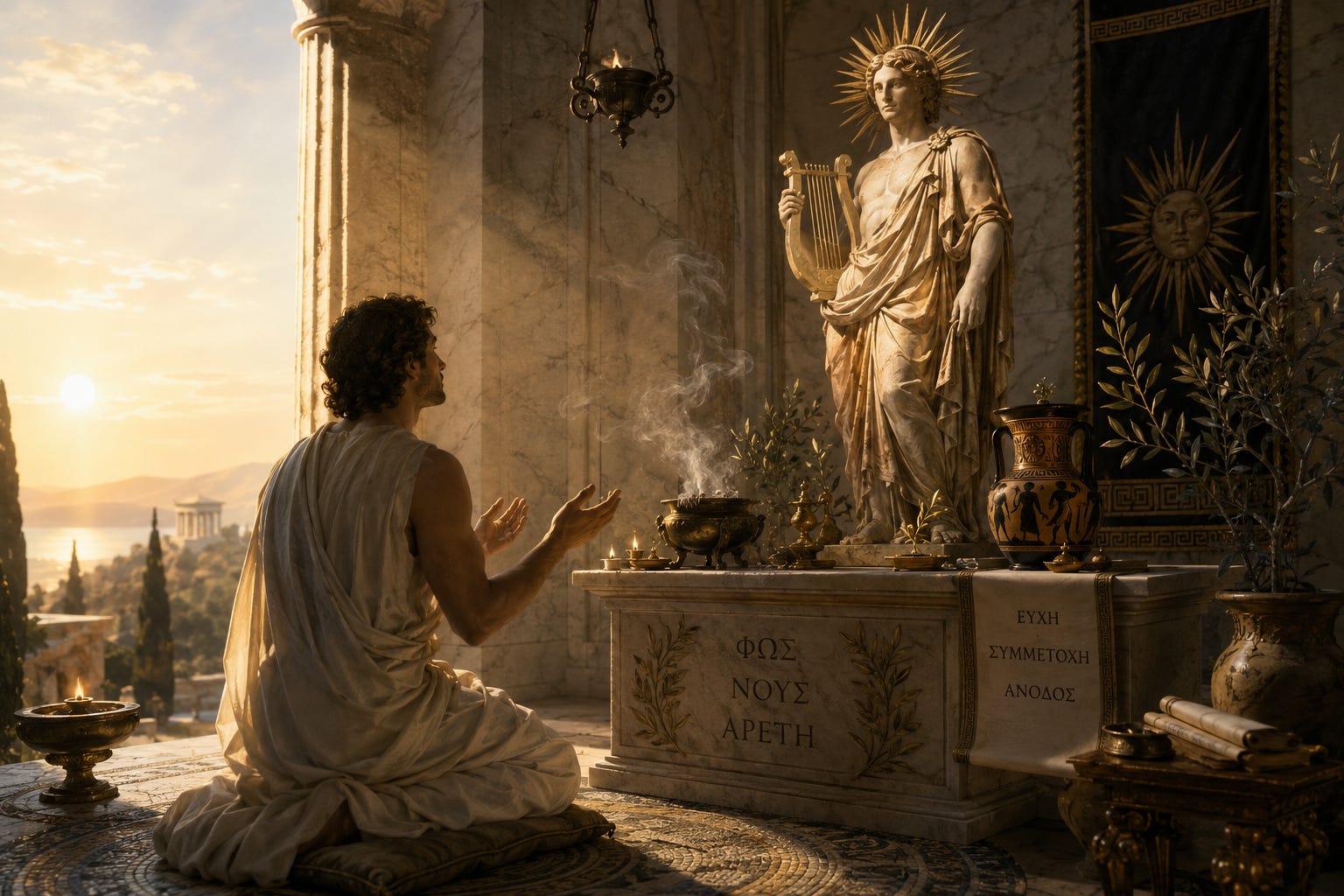
One of the strangest questions that repeatedly appears in modern discussions of Neoplatonism is whether prayer makes any sense at all; and if you have been following my entire series on Platonism, the concern is understandable.
The moment most beady-eyed, innocent Pagans learn that the gods of later Platonism and of the highest Hellenic philosophical echelons are not imagined as giant invisible humans floating somewhere above the clouds, a certain confusion begins to emerge in their troubled, formerly Christian minds.
And no, I do not think that is because they are stupid—the issue here is real.
If the gods are eternal causes rather than super-powered individuals riding the clouds, transforming into hyper-sexual swans in search of beautiful women to impregnate, then who exactly is listening?
If the gods exist beyond time, what could anyone’s prayer possibly tell them that they do not already know and understand the necessity for?
And if the gods are perfect, why would they alter their behaviour and intervene in our mundane affairs because a small Mediterranean, shaven ape standing in front of a statue, suddenly begins reciting elaborate metric poetry?
Did we not conclude that we cannot control the gods?
So yes, the questions do sound reasonable, and the Pagans—for once—cannot be faulted.
Unfortunately, however, their questions are also built upon assumptions that would have appeared rather peculiar to the very philosophers whose theology we are attempting to understand and practice.
The difficulty here begins with the word “person.”
Modern religious culture has trained us to imagine divinity through categories derived largely from Abrahamic devotional life.
God is frequently conceived as a supreme person possessing thoughts, intentions, emotions, preferences, and grand plans that end up requiring sacrificing his own son to himself in order to forgive the mistake his imperfect creations made, the one that he knew they would make anyway because he is also omniscient.
Prayer to someone like this, therefore, inevitably becomes something resembling a conversation. One speaks. God listens. God responds—although you frequently wish he didn’t.
The Platonists did not entirely reject this model —you thought it was going to be that easy, didn’t you?
But they did not entirely accept it either.
The Platonic position occupies a space that many modern minds may find somewhat uncomfortable to reconcile with because it simply refuses to fit neatly into either aforementioned category.
