
The Divine Compendium
Proclus on the Gods and the Architecture of Reality

My dearest loves,
There are some thinkers one reads for insight, some for inspiration, and some because they preserve fragments of a world that has otherwise been shattered.
Proclus is one of the rare few one reads for all three.
He stands near the end of the polytheist Greek philosophical tradition, but not as a mere tired curator of old doctrines.
He is not merely preserving scraps from Plato, Plotinus, Iamblichus, Orpheus, and the Chaldean Oracles—he is actively and masterfully building with them.
He takes the old inheritance and gives it a structure so complete, so deliberate, and so internally ordered that one begins to understand why later admirers treated him less like a commentator and more like an architect of the entire temple of Platonism as a complete lived practice and the complete flowering of the Hellenic tradition.
Because architecture is exactly the right word for what he does.
What Proclus gives us is not a loose collection of spiritual ideas, nor a few mystical slogans stitched to mythology, nor even just “Platonism with more gods.” What he gives us is a complete and full divine universe: layered, luminous, populated, hierarchically ordered, and held together from its highest summit to its lowest material extremity by a continuous chain of causation and participation.
But there is a problem.
When modern readers first approach Proclus, they usually encounter the system in fragments.
One book discusses the henads.
Another talks about Intellect.
Another about Soul.
Another about daimones, theurgy, or the gods in Plato’s Timaeus.
So a vision that is actually very ordered, when presented in that format can begin to look chaotic. As one goes on reading through his writings, one sees names repeated everywhere—Zeus here, Zeus there, Helios above, Helios below, gods beyond being, gods in Intellect, gods in Soul, gods in the planets, gods in springs and cities—and starts to suspect that this is either a pious tangle or a very elaborate confusion.
I assure you, it is neither.
It only looks that way when the architecture has not yet been made explicitly visible.
That is what this piece is for.
What follows is meant to be as full and coherent an introduction to the metaphysical structure of the Proclean universe as time and space will allow. It is written for the intelligent beginner, for the reader who may know little or nothing about Platonism, and who wants not scattered remarks but a whole system presented clearly. But that does not mean that those tricksy kitten among you who have followed my series about platonic thought from the beginning will not also benefit.
Forgive me the reiteration of ideas and points previously covered, but I must assume that we will always have newcomers and they must not be left to tarry in confusion and darkness.
So I will move slowly.
I will define terms when they first appear.
I will explain the function of each level before introducing the gods that operate in it.
If we do our work properly here, by the end, the Proclean universe will no longer feel like a pile of ancient names but will feel like what it is: a living cathedral of reality.
So let us get into it.
I. The Older Platonic Framework
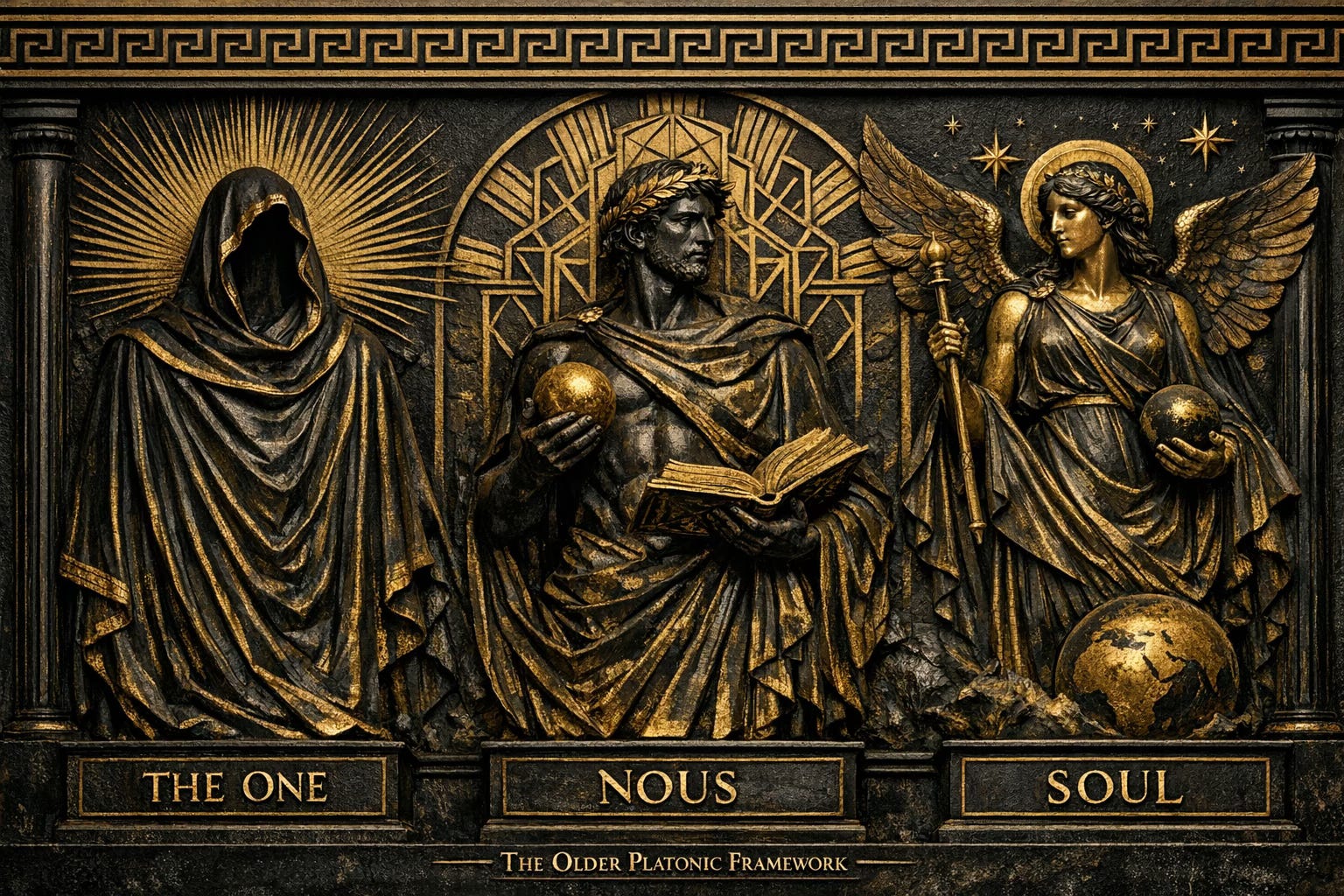
Before we can understand Proclus, we must review the simpler framework he inherits.
The classical Platonic tradition presents reality in terms of three great principles: the One, Nous (Intellect), and Soul.
If one does not understand this threefold structure, Proclus will look more unfamiliar than he really is.
Proclus does not abolish this framework—he deepens it with elements he inherits from Iamblichus and his successors and then justifies mathematically as we said in the last post about him.
So let us start at the beginning by looking at what Proclus starts with and then we can insert his contributions after we establish the main framework he was working within.
1. The One
The One is the first principle of all things. It is absolute unity.
This concept always trips people up, especially on account of the influence of monotheism in Western culture, but it is important that it is understood carefully.
The One is not simply the highest being in the universe.
It is not a giant object at the top of reality.
It is not “one thing” alongside other things, only more powerful.
It is prior to that whole field of comparison.
But why even posit such a principle?
Because everything we encounter is “many” in some respect. A body has limbs and organs. A society has citizens. A word has letters. A melody has notes.
Yet each of these also counts as one thing.
It hangs together.
So the Platonists asked: what makes that togetherness possible? Their answer: every manifold thing participates in “unity.” It is one because it shares in it. But if manifold things receive this unity and not produce it—they cannot, as they depend on it being there—then it must come from somewhere else. It must have a source. That source cannot simply be another manifold thing.
There must be a first principle that does not borrow its unity from elsewhere, but simply is one.
That is the Platonic One: the source of all order, all togetherness, all coherence, all identity, all relation.
Without it, reality would not merely be messy. It would not hold together at all.
2. Nous
The second great principle that Proclus inherits is Nous, usually translated as Intellect.
By “Intellect,” Platonists do not mean mere brainpower or a faculty for doing logic puzzles.
They mean the divine realm of intelligible reality, the level at which truth is fully present, perfectly ordered, and eternally knowable.
This is the domain of the Forms that Plato talked about: Justice itself, Beauty itself, Equality itself, Life itself.
The eternal patterns or paradigms according to which lower things exist.
If the One is like pure undivided light, then Nous is the first complete illumination of reality as intelligible order.
If the One is the source of unity, Nous is the realm in which that unity is first unfolded into a total, intelligible cosmos of truth.
3. Soul
Soul is a mediator.
It receives intelligible order from Nous and communicates it downward into motion, life, time, and cosmic activity.
If Nous is the realm of eternal intelligible structure, Soul is the principle that animates, transmits, and enacts that structure in a living world.
Let us return to our favorite analogy, one that we have been using from the beginning of this series: consider a piece of music.
The One is the source of the unity that allows it to be one composition at all.
Without it, there are only notes, none of which necessarily belong to that composition.
It is the presence of the One that makes the coming together of these notes a possibility.
Nous is the complete intelligible form of the composition—the whole piece known in its total structure. The composition as a fifty-page collection of all the notes, meters, accents, and orchestration options before it is even written down. It’s all there, stagnant, eternal, preserved.
Soul is the performance of that piece: the bringing of intelligible order into movement, succession, sound, and living presence. It is the piece played out, note by note in successive time, unfolded, moving and “alive,”interpreted in many flavors by different orchestras and performers.
Without Soul, the world would not happen. The Forms would remain intelligible truths without becoming a cosmos.
This, then, is the old Platonic framework: the One as source, Nous as intelligible order, Soul as living mediation.
Everything in Proclus presupposes this tripartite structure.
